
Hopefully, the grey world of central banking in a nation hit by demonetisation, will lighten up with some of his notes soon.

His likable boy-next-door face and casual approach to public speaking have a unique appeal for the younger generation, but it stops there, observes N Sathiya Moorthy.

Tamal Bandyopadhyay offers some unsolicited advice for a government wh,ich came to power, with brute majority and the nation's pragmatic chief money man.
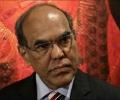
In his new role, Subbarao will take part in various activities at NUS Business School, the Institute of South Asian Studies and the Monetary Authority of Singapore.
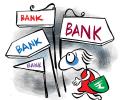
In the new decade, the scene will change because the banks till recently had been challenged by the fintechs, but the techfins have now entered the arena, observes Tamal Bandyopadhyay.
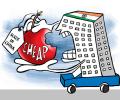
We import from China not because we love China, but because they sell us these things at cheap prices, points out Rathin Roy.
The non-oil, non-finance sector of the economy is under severe stress.
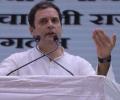
Rahul said that an atmosphere of fear has been prevailed in the country.
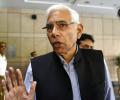
'And who sold this belief?' 'Public-spirited individuals' like Subramanian Swamy.' 'Independent public servants' like Vinod Rai. 'Anti-corruption activists' like Kiran Bedi. And 'outspoken television anchors' like Arnab Goswami,' says Mihir S Sharma.

Watal panel had suggested an independent payments regulator be set up.

Practising Indira Gandhi's brand of socialism today will not just be anachronistic but also economically harmful.

The government has at last commenced important structural reforms.
Reserve Bank of India Governor Raghuram Rajan had said recently that there was "no need" to set up a separate bad bank to deal with stressed assets of public sector lenders.

What is required from government is intellectual framework.
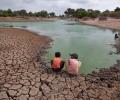
Renewable energy is mistakenly restricted to electricity.

Jaitley asserted that the party has become the central pole of Indian politics.
N R Bhanumurthy, professor of economics at the National Institute of Public Finance and Policy, and the author of the series, presented in a report to the National Statistical Commission, explains to Abhishek Waghmare various aspects of the methodology.
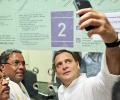
The IIM-B's 'Karnataka innovation report' has become the basis for the Congress party's election narrative, particularly to distinguish it from the 'Gujarat model of development', reports Archis Mohan.

'You cannot fight a disease as complex as COVID-19 without a carefully calibrated, localised response.'
Reform ideas do not occur overnight and evolve over the years.

All FIPB records will now be digitised; old and unnecessary files will be weeded out

The resignation is sure to create more political firestorms for the government as it comes on the eve of the winter session of Parliament where the Opposition has already made it clear to the treasury benches that infringing on the RBI autonomy would be a big talking point for them.
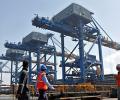
Special Economic Zones are likely to be central to realising Prime Minister Narendra Modi's ambitious Make in India agenda.

If oil prices rise, the government would face an uncomfortable political decision.

Moody's Investors Service on Friday said India's economy is expected to contract for the first time in more than four decades saying economic damage owing to the coronavirus-induced lockdown will be significant with lower consumption and sluggish business activity. Even before the coronavirus outbreak, Indian economy already was growing at its slowest pace in six years and with the stimulus measures announced by the government falling short of expectations, the disruptions are likely to be greater. "We now expect India's growth to register a real GDP contraction for the fiscal year ending in March 2021 (fiscal 2020-21), from our earlier projection of zero growth," it said in a research note.

'The new government will have to contend with slowing economic growth, weak private investment, anaemic exports and vulnerable external imbalances, a stressed financial system, mounting fiscal pressures (including high government debt-to-GDP ratios) and an exceptionally bad employment situation,' says Shankar Acharya, former chief economic adviser to the Government of India.

Indians want change and progress. They should be willing to accept tough decisions, says Sanjeev Nayyar.

The RBI cited lower-than-expected inflation, weak crude prices and weak demand, as well as the government's commitment to sticking to a fiscal deficit target as reasons.

The finance ministry has put out a revised draft in public domain.

'Rahul is only making a pathetic public spectacle of his lack of judgment and good sense by hallucinating that somehow, the Congress, or whatever political combine is cobbled together, will displace the BJP at the coming Lok Sabha election by constantly harping on the Rafale deal,' argues retired civil servant B S Raghavan.

The prime minister sees himself as the "vikas purush". But realising his government's agenda for development requires not just a more efficient administration but also a credible implementation plan, says Nitin Desai.

Officials said both the factions of the Hurriyat are likely to be banned under Section 3(1) of the Unlawful Activities (Prevention) Act, or the UAPA, under which "if the Central Government is of opinion that any association is, or has become, an unlawful association, it may, by notification in the Official Gazette, declare such association to be unlawful."

What is killing the risk appetite of the bond buyers is the inconsistency in the central bank's approach. It needs to allow the yield to find its own level, gradually. To ensure that, the RBI may adopt a similar approach with which it handles a slipping rupee, asserts Tamal Bandyopadhyay.

'Mr. Modi has now become 1st PM to have his illegal orders set aside by the SC'

The niche banks - small finance and payments banks -have been set up to further the regulator's objective of deepening financial inclusion.

The notes argue that it will widen the talent base available to govt to deliver increasingly complex services to a demanding population.

Union Finance Minister Arun Jaitley today said demonetisation left Maoists in many parts of India and separatists in Jammu and Kashmir "fund starved".

'Instead of doing reforms and restructuring, the present government is busy with the perception that everything is fine and the economy is hunky-dory.' 'Such hollow perceptions are very dangerous for the Indian economy in the long run.' 'The real risk to India is the lack of decent employment opportunities for youth in general and educated youth in particular.'
'If you look at household hospitalisation compensation, then you will find only one-third is hospitalisation. Two-thirds is outpatient.' 'Even if you provide Rs 5 lakh coverage, people will still have a tough time.'
'If development, investment, employment, implementation, credibility and commitment are ensured, security will automatically improve and subversive and militant elements will lose ground and be neutralised by the people themselves,' says B S Raghavan, the distinguished civil servant.
